



Зміст статті
What Is AI Marketing?
AI marketing is an approach in which artificial intelligence is involved in the planning, execution, and analysis of marketing activities. At its core are machine learning, natural language processing (NLP), and predictive analytics. These technologies allow systems to analyze data, identify patterns, and automatically adapt to changing conditions.
In practice, it looks like this: a recommendation algorithm analyzes a user’s purchases and suggests the next product; an email system determines the optimal delivery time for a specific subscriber; a content generator writes five ad headline variations in 10 seconds. All these processes share one thing in common: the algorithm makes the decision, while the marketer sets the strategy and reviews the result.
The AI marketing market is growing rapidly. According to Grand View Research forecasts, by 2030 its volume will reach $82.23 billion — compared to $20.44 billion in 2024. This confirms: marketing automation with AI is not a passing trend, but a structural shift in the industry.
How Can Marketers Use AI?
The range of applications is wide — from small tasks to strategic decisions.
Content generation. Blog posts, ad copy, social media content, video scripts — AI tools can create or refine materials according to a given tone and structure. A copywriter working alongside an AI generator handles 3–5 times more tasks than they would alone.
SEO optimization. Automatic keyword selection, competitor analysis in search results, recommendations on content structure and internal linking — AI platforms handle all of this in a matter of minutes.
Audience analysis. Behavioral segmentation, customer churn prediction, identification of the most valuable segments — tasks that previously required an analyst working for several days are now resolved automatically.
Personalization. Recommendation engines on websites, dynamic content in email campaigns, targeting based on real behavioral signals rather than broad demographic groups.
Communication automation. Chatbots, auto-replies, configured trigger email sequences — AI tools handle all of this without a manager involved in every individual conversation.
Media generation. Images, video, voiceover — without an in-house designer or videographer. A one-person team can produce content that previously required an entire production studio.
Pros and Cons of Neural Networks
Advantages:
- Speed. A task that takes a person several hours, AI completes in minutes. For a team with a tight deadline schedule, this is a critical advantage.
- Scalability. A single tool can simultaneously process thousands of scenarios — A/B tests, ad variations, personalized recommendations for different audience segments at the same time.
- Working with big data. People struggle with arrays of millions of rows. Neural networks handle them well — and do so without errors caused by fatigue.
- Reduced operational costs. Fewer routine tasks means fewer man-hours spent on them. The team’s capacity is redistributed toward strategic work.
- Continuous operation. AI tools don’t take vacations and don’t have days off. A chatbot or analytics system runs 24/7.
Disadvantages:
- Lack of contextual understanding. AI doesn’t sense the nuances of a brand, the cultural characteristics of an audience, or situational humor. The output requires human editing.
- Factual accuracy issues. Language models sometimes generate incorrect data — so-called “hallucinations.” Everything involving numbers and facts should be verified.
- Dependence on input data quality. If the analytics fed in are inaccurate, the output forecast will be equally unreliable.
- Legal risks. Copyright over generated content and the handling of personal data are issues still being worked out in legislation across different countries.
- Learning curve. To get quality results from an AI tool, you need to know how to formulate tasks correctly. Prompt engineering is a separate skill worth developing.
Top 15 AI Marketing Tools
A selection of AI tools from Atlant Digital that our specialists use on a daily basis.
Text Generation
Jasper AI
Jasper is one of the most well-known AI tools for writing marketing content. The platform is trained on billions of marketing texts and is focused specifically on commercial tasks: ad copy, landing pages, email campaigns, social media posts, and product descriptions.
The key advantage is the Brand Voice feature. You upload samples of your own materials, and the system adapts its generation style to match your tone. Jasper supports over 30 languages and has a built-in integration with Surfer SEO — you can optimize content for search queries right away without switching between tabs. Plans start from $39 per month.
Writer
Writer is an enterprise platform for team content writing with AI support. Unlike Jasper, the focus here is on consistency: the entire team writes in the same tone, with no discrepancies in terminology or style, regardless of how many authors are involved.
Among enterprise platforms aimed at B2B teams, Writer stands out for its advanced brand guideline management features — you set the rules, and the system enforces them at the level of every author. It includes fact-checking, a built-in editor, content compliance analysis against corporate standards, and terminology control. Best suited for mid-sized and large teams.
Copy AI
Copy AI focuses on the rapid generation of short marketing formats: ad headlines, product descriptions, email subject lines, CTA phrases, and social media captions. The interface is simple: choose a template, enter a few words about your product — and get several options to choose from.
For a marketer who needs to quickly test 10 different ad variations or email subject lines, Copy AI is a convenient solution. There is a free plan with a limited number of generations; paid plans start from $36 per month. One of the most accessible options for getting started with AI copywriting.
Grammarly
Grammarly is more than just a grammar checker. The current version with AI features helps rewrite sentences, adjust tone (formal, friendly, or persuasive), trim text without losing meaning, and detect plagiarism.
For a marketer, it is primarily a quality control tool for final materials. Before sending a business proposal, publishing an article, or launching an email campaign — Grammarly catches what the human eye misses even after a third round of edits. There is a free version; the paid version starts from $12 per month. Primary support is for English, though partial functionality for other languages is also available.
GrowthBar
GrowthBar is an AI-powered SEO tool with built-in content generation. Its distinctive feature: it doesn’t just write text — it first analyzes competitors for a chosen keyword, examining their structure, headings, word count, and backlinks, then builds a content plan based on that data.
For marketers focused on organic traffic, this is a significant advantage: the material is immediately tailored to search result requirements rather than written in a vacuum. GrowthBar also shows competitors’ keywords and their Google Ads campaigns. Plans from $29 per month.
Image Generation
DALL-E
DALL-E by OpenAI generates images from text descriptions. A marketer describes a scene, style, and color palette — the system produces a ready image in seconds. The quality and control of the output depend directly on how detailed the prompt is.
For marketing, DALL-E works best for article illustrations, ad campaign concepts, and unique images for social media — in places where stock photos look generic. Available through ChatGPT Plus and via API. Cost starts from $0.04 per image depending on size and quality. Among AI image generation tools — the easiest to access.
Midjourney
Midjourney is considered the benchmark for visual output quality among marketers and designers. The system excels at artistic styles, atmospheric illustrations, brand visuals, and conceptual imagery where aesthetics matter.
It operates through Discord — an unusual entry point, but most users adapt within a few sessions. Subscriptions start from $10 per month. One important detail: Midjourney has become significantly better at rendering realistic people than it was two years ago, opening up new possibilities for ad materials without organizing photo shoots.
Video and Audio Editing
Synthesia
Synthesia allows you to create videos with an AI avatar — no camera, microphone, or studio required. You write a script, choose an avatar and language — the system generates a video where the character delivers your text with correct lip sync and natural movement.
For marketing teams, this solves a specific problem: training materials for clients, corporate videos, product announcements, personalized video messages. Synthesia supports over 130 languages and accents. The basic plan starts from $22 per month. As of 2025, it is one of the most mature platforms for video production without a film crew.
Descript
Descript is a video and audio editor where editing happens through text. Automatic transcription converts a video recording into a text document: delete a word in the text — it disappears from the video. Cut a paragraph — cut the corresponding video segment.
Beyond editing, Descript features one-click filler word removal, AI-powered voice replacement, and automatic subtitle generation. For podcasts, webinars, and educational video content — a noticeable time saver even without video editing skills. There is a free plan; paid plans start from $12 per month.
Analytics and SEO Optimization
LeadIQ
LeadIQ is a platform for B2B marketers and sales teams that automates the collection and verification of prospect contact data. A browser extension lets you capture a contact from LinkedIn in one click and immediately send it to a CRM or an email outreach sequence.
AI in LeadIQ analyzes profiles and helps personalize outbound messages based on publicly available data about a lead’s company: recent news, organizational changes, product launches. This reduces research time before outreach and increases the relevance of communications. There is a free plan; paid plans start from $36 per month.
Fullstory
Fullstory is a platform for analyzing user behavior on a website. It records sessions, builds heatmaps, and tracks where users stop, where they abandon incomplete forms, and where they click in the wrong places.
For a marketer, it is a source of hypotheses for CRO — conversion rate optimization. Instead of guessing why a button isn’t working, you watch a recording of a real session and see the problem with your own eyes. Someone doesn’t understand the form — and leaves. Someone doesn’t see the button on mobile. Someone reaches the pricing page and closes the tab. All these scenarios are captured and grouped automatically by Fullstory. The AI within the platform detects anomalies and conversion drops, flagging issues before they become critical for the business.
Surfer
Surfer is an AI tool for optimizing content according to search engine requirements. It analyzes the top 20 search results for a chosen query and delivers specific recommendations: how many words the material should contain, which NLP terms to use and how many times, and what heading structure is optimal.
Surfer stands out by providing numerical recommendations rather than general advice. There is a built-in editor with a score counter — you write and immediately see how well the material meets search result requirements. Plans from $79 per month, with a trial access available.
Seventh Sense
Seventh Sense is an AI platform for optimizing email send times. It analyzes each subscriber’s behavior — when they typically open emails — and delivers messages at an individually selected moment for each recipient.
At first glance, a secondary detail. But for a marketer sending tens of thousands of emails, the difference between the “right” and “wrong” delivery time can mean a 20–30% difference in open rates. Seventh Sense integrates with HubSpot and Marketo. Pricing starts from $80 per month for HubSpot users.
Chatfuel
Chatfuel is a platform for building chatbots on Facebook Messenger, Instagram, and WhatsApp without writing any code. A marketer builds a scenario through a visual constructor, connects AI responses — and the bot starts handling customer inquiries around the clock.
Among AI communication automation tools, Chatfuel has one of the lowest entry thresholds. For e-commerce and service businesses, it handles the initial contact: answering frequently asked questions, qualifying leads, and booking consultations. There is a free plan for up to 50 conversations per month; paid plans start from $14.99 per month.
Meet Edgar
Meet Edgar is an AI tool for automating social media publishing with a content recycling feature. The core idea: you upload materials into a library organized by category, set a schedule — and Edgar automatically publishes posts; when the library runs out, it starts a new cycle from the beginning.
For a marketer managing multiple accounts or looking to maintain social media activity without daily manual posting, this is a convenient automation. Meet Edgar supports Facebook, Instagram, LinkedIn, Twitter/X, and Pinterest. Plans from $24.91 per month.
How Different Industries Are Implementing AI in Marketing
AI in marketing doesn’t look the same across different sectors. Tasks and priorities vary depending on the industry and business model.
- E-commerce. Recommendation engines analyze browsing and purchase history to show relevant products at the right moment. AI chatbots handle customer inquiries around the clock without a manager involved. Dynamic pricing automatically adjusts costs based on demand, competitors, and inventory levels.
- FMCG and retail. Demand forecasting through machine learning enables more accurate inventory planning, avoiding both shortages and surplus. Personalized loyalty programs — where bonuses and promotions are tailored individually to each customer — show higher retention rates compared to uniform discounts for everyone.
- B2B and SaaS. The focus is on predictive lead scoring: AI analyzes behavioral signals and determines which leads are more likely to convert. Automated outreach sequences with personalized messages based on publicly available data about a lead’s company generate higher response rates than mass template emails.
- Media and content marketing. AI distribution tools determine the optimal publication time, format, and headline for each channel individually. Automatic transcription and content repurposing — from webinar to article, from video to posts — speed up production and help extract maximum value from every piece of content.
- Real estate and financial services. Personalized recommendations for properties or financial products based on a client’s profile. Automatic generation of property descriptions and analytical reports. Chatbots for initial inquiry qualification before a live agent steps in.
💡 Common to all industries: AI doesn’t replace the marketer — it amplifies the team’s ability to make decisions faster and on better data.
Which AI Tools Does Atlant Digital Use?
AI tools are embedded in every specialist’s workflow — from strategist to copywriter.
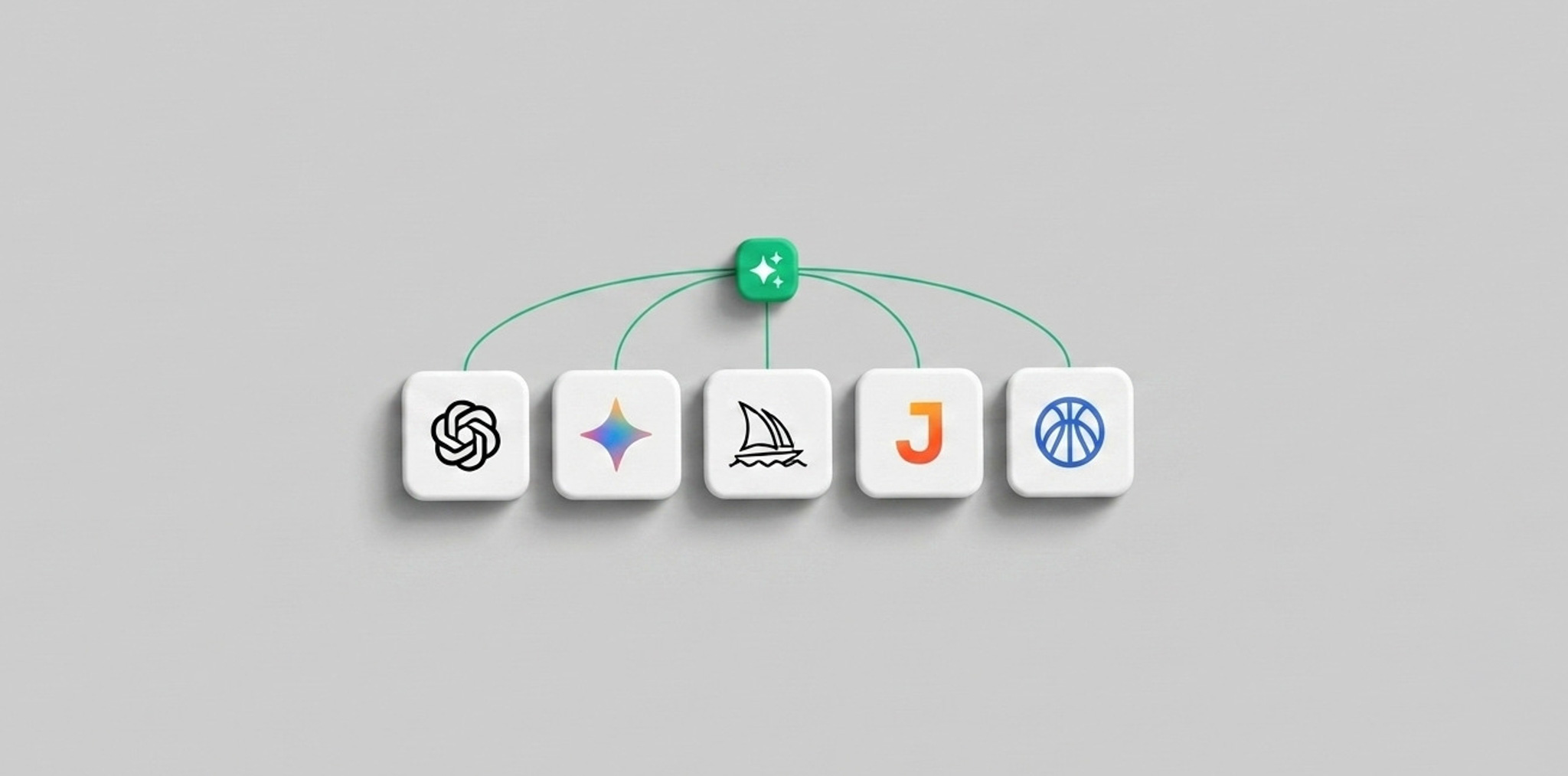
- ChatGPT and Claude — for brainstorming, draft content, answers to technical questions, and analysis of large data sets. They accelerate the early stages of working on a piece and help generate hypotheses for testing.
- Jasper AI — for generating marketing texts in the style of a specific client. A configured Brand Voice reduces editing time and brings all materials to a consistent tone regardless of who on the team is writing.
- Surfer SEO — for optimizing articles for search queries. Every piece of content is checked against key metrics before publication.
- Midjourney and DALL-E — for creating unique visuals where stock photos look out of place or too generic.
- Chatfuel — for automating the first point of contact with potential clients in messengers. The bot qualifies inquiries and passes ready leads to account managers.
The rollout happened gradually: individual tasks first, then integration into full workflows. This approach allows quality to be maintained without losing the team’s expertise. We also keep track of new releases: the AI tools market updates every month, so what required an expensive solution a year ago is often available on a free plan today.
Want to figure out which AI tools fit your business needs — leave a request and we’ll walk through your case together.
FAQ
AI accelerates three key processes: content production, data analysis, and communication personalization. Marketers get more hypotheses in less time, test them faster, and make decisions based on more accurate data.
No — but it can replace marketers who refuse to learn how to work with AI. Artificial intelligence handles routine tasks, pattern recognition, and scaling well. It struggles with strategic thinking, building trusted relationships with clients, and creative decisions that go beyond its training data. A marketer who knows how to set the right tasks for AI and critically evaluate the output becomes more effective.
Start with the task, not the tool. Identify what takes the most time or where the most errors occur: content generation, audience analysis, SEO, client communication. Then find platforms that address exactly that task and test 2–3 options on a free plan. There’s no point paying for full functionality until you’re sure the tool fits your process.
The main categories are:
- Text generation and editing — Jasper, Copy AI, Grammarly, Writer, GrowthBar.
- Image and video creation — Midjourney, DALL-E, Synthesia, Descript.
- SEO and content analytics — Surfer, GrowthBar.
- Behavioral analytics — Fullstory.
- Email optimization — Seventh Sense.
- Communication automation — Chatfuel, Meet Edgar.
- B2B outreach — LeadIQ.
The platforms can be combined — it is the combined approach to selecting AI tools that delivers the best results.