



Зміст статті
E-E-A-T in Brief: What Does the Abbreviation Stand For?
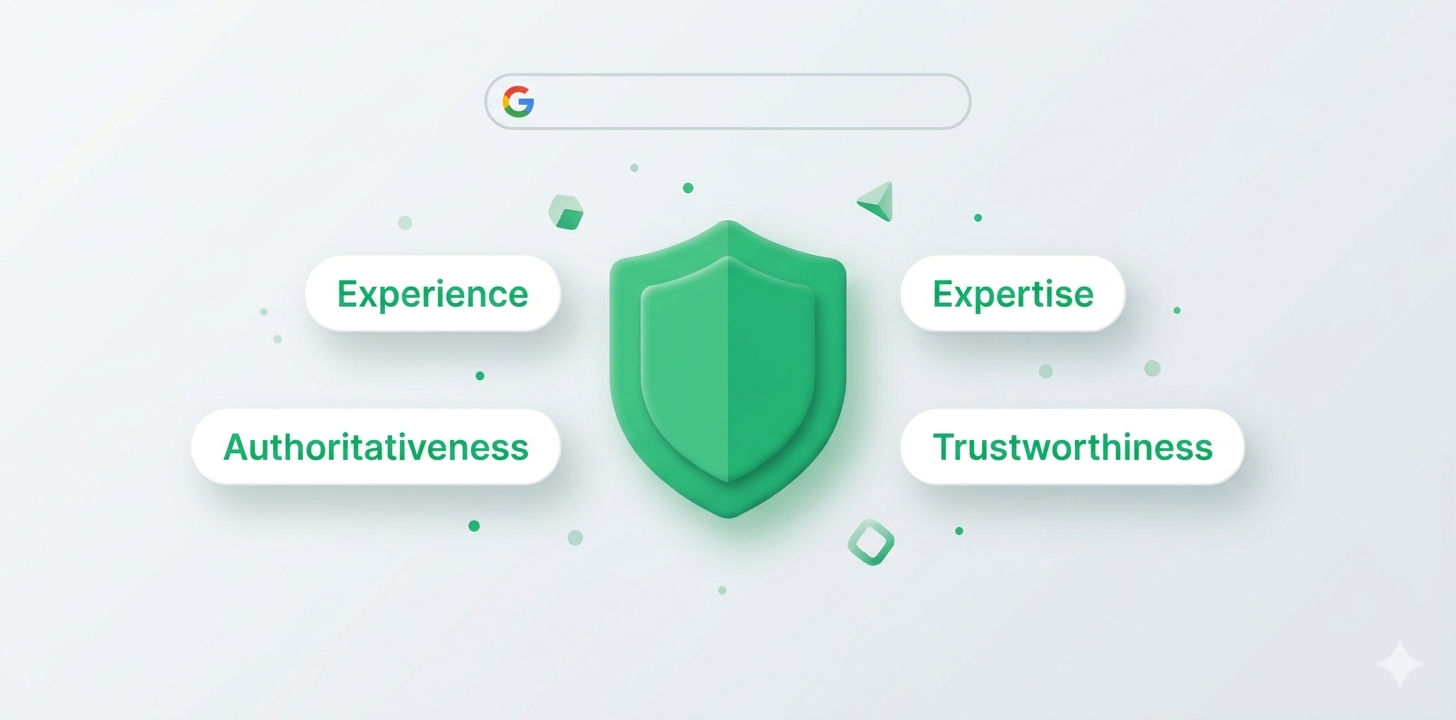
Four letters — four questions Google asks about every page: Does the author have real experience (Experience)? Is it backed by knowledge (Expertise)? Do others recognize it (Authoritativeness)? And can the site be trusted at all (Trustworthiness)?
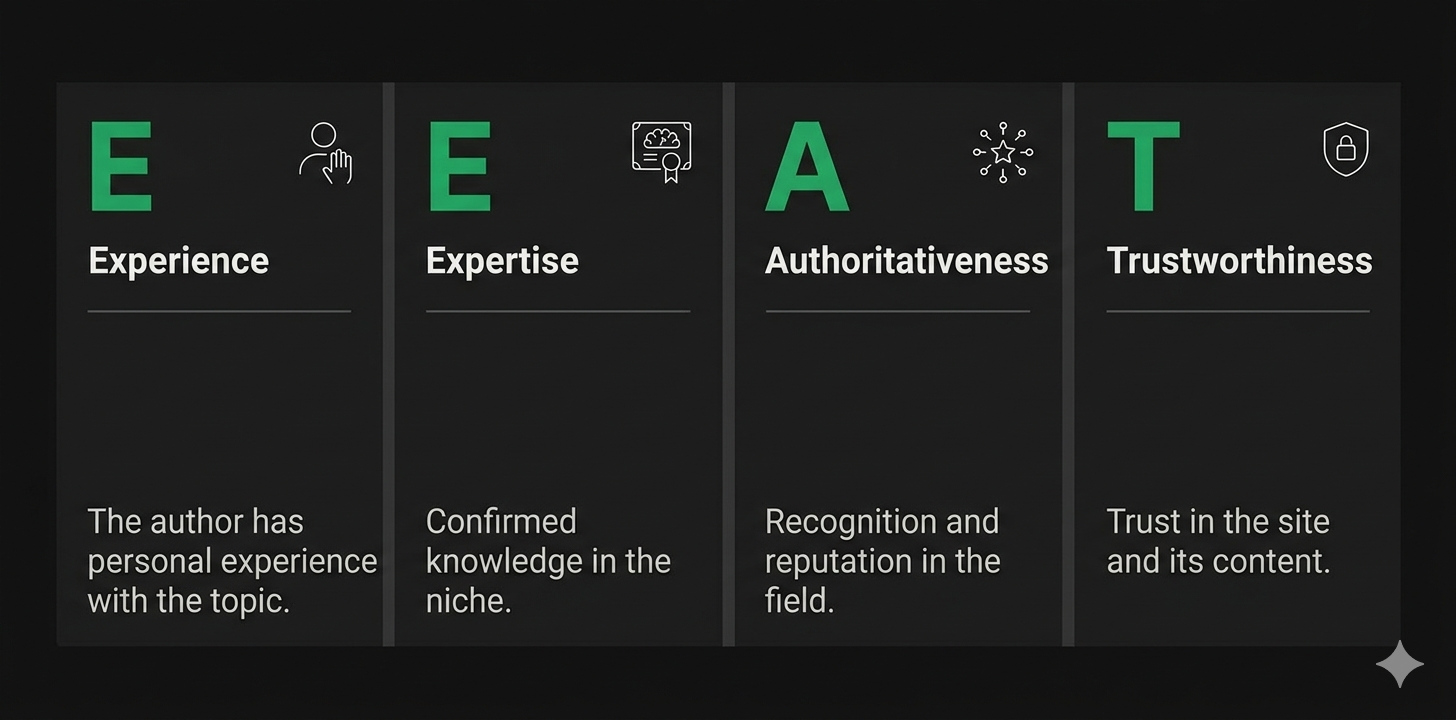
It’s important to understand from the start: E-E-A-T is not a set of technical settings and not a checklist that can be “upgraded” in a week. It is a comprehensive assessment of how much your website deserves trust — both in Google’s eyes and in the eyes of real people.
What Is Google E-E-A-T SEO
Google E-E-A-T SEO is an approach to website promotion in which content quality and resource reputation become central priorities. Simply put: instead of “tricking” the search engine with technical tricks, you build a site that Google and people genuinely trust.
To understand how the search engine evaluates web resources, picture this. There are special people — Quality Raters. They receive a task: open a certain resource and evaluate it according to clear criteria.
🔍 Is the author a real person with experience?
✅ Can the information be trusted?
🏢 Is it clear who stands behind the platform?
These assessments do not directly change your domain’s positions, but it is on their basis that the algorithm learns to distinguish quality web projects from weak ones.
In 2025–2026, these signals have become even more important due to AI Overviews — a new Google feature that shows an AI-generated answer directly above search results. Only content from sites that the algorithms trust most gets into these answers. Sites below this threshold don’t appear in AI Overviews at all.
2.1. Experience
Experience is the first and newest element of the concept. It answers a simple question: did the author personally encounter the topic?
Here is a concrete example. There are two headphone reviews. The first is written by someone who used them for three weeks: it describes the sound, comfort, how they stay on during a run, and where they started to chafe after two hours. The second is rewritten from the manufacturer’s official platform. Algorithms are getting better at telling the first from the second — and ranking the first one higher.
Signs of real experience in a text:
- personal photos or screenshots
- specific details not found in official descriptions
- description of unexpected results or mistakes
- before and after comparisons
Generic phrases without specifics are, on the contrary, a signal that the author doesn’t know the topic from the inside.
2.2. Expertise
Expertise is the depth of knowledge and qualification of the author or site in a specific topic. For medicine, law, and finance, confirmed professional competence is required: degrees, licenses, stated specialization. Material about treatment must have a medically trained author or at least a doctor-reviewer.
For other niches — technology, marketing, hobbies — demonstrating practical knowledge through quality, detailed content is sufficient.
But the key word here is “consistently”: if a site positions itself as an SEO agency, all content must match that claim. One quality piece among ten empty ones doesn’t save the overall picture.
2.3. Authoritativeness
Authoritativeness is the reputation of the author and the site in their niche. It is assessed through external signals: whether authoritative resources link to you, whether media cite you, whether you are mentioned in industry discussions. Authoritativeness is what others say about you — not what you write about yourself on the “About Us” page.
It is built over years:
- a quality backlink profile
- publications in authoritative outlets
- media presence of company speakers
- participation in industry events
Authoritativeness cannot be bought, but it can be steadily earned through reputation work.
2.4. Trustworthiness
Trustworthiness is the most important of the four criteria. Google explicitly states in its guidelines: the other three elements — Experience, Expertise, and Authoritativeness — serve as evidence of trustworthiness.
Signals of a trustworthy site:
- HTTPS secure connection
- up-to-date contact information
- transparent privacy policy
- honest “About Us” page
- absence of misleading or clickbait headlines
- correct authorship attribution
For e-commerce — transaction security and transparent return policies.
Trustworthiness is not just technical parameters. It is the overall feeling: is a person ready to trust your site with their money, health, or an important decision?
E-E-A-T and YMYL Sites
YMYL (Your Money or Your Life) is a category of resources where false or inaccurate information can genuinely harm a person. Google places the following in this category: medicine, law, finance, news and media, government services, safety, nutrition and fitness, education, real estate.
For YMYL sites, Google applies the strictest content quality standards. If you publish materials about disease symptoms, legal advice, or investment tips — the author must be a verified specialist, sources must be verified, and content must be regularly updated. Ignoring these requirements leads to a sharp drop in positions after every Core Update.
Why such strict requirements? The cost of an error varies: an inaccurate cake recipe — a ruined dessert; inaccurate information about medication — real harm to health. The higher the stakes, the stricter the requirements.
But there is an important nuance: YMYL criteria are relevant to varying degrees for most sites. If your content in any way influences a user’s decisions, wallet, or well-being, Google will evaluate you by elevated standards.
Why E-E-A-T Matters for Business
You can view E-E-A-T as just another headache — yet another checklist of requirements from Google. Or you can see it as a competitive advantage. Businesses that systematically build trust and authority gain much more than just search positions.
What strong trust and authority signals specifically deliver:
- Higher positions in competitive niches — especially where the topic overlaps with YMYL.
- Presence in Google AI Overviews — the algorithm pulls answers from the most authoritative sources.
- Lower bounce rate — users who land on an authoritative resource read more carefully and longer.
- Higher conversion rate — people are more willing to buy from someone they perceive as an expert.
- Resilience to algorithm updates — sites with a strong reputation foundation far less often lose traffic after Core Updates.
- Branded traffic — positive reputation in external sources stimulates direct and branded search queries.
There is one more point that is often overlooked: this system of signals affects how potential partners, clients, and media perceive your brand outside of search. A strong online reputation is an asset that works on all fronts.
The Importance of Google E-E-A-T for SEO
Every major Google update in recent years — Helpful Content Update, Core Updates, Spam Updates — concerns quality and trust criteria. The algorithm is learning to better identify sites that imitate quality versus those that genuinely demonstrate it.
Platforms that ignore trust and authority signals lose positions after every major update. Meanwhile, resources with a strong foundation withstand algorithmic changes and continue to grow organic traffic even in competitive niches.
SEO without work on trust is chasing short-term results. Manipulative content or artificial links may temporarily work — but at the first Core Update, positions will collapse. Trust built systematically is insurance against such scenarios and a long-term investment in organic growth.
Is Google E-E-A-T a Ranking Factor
It is important to clarify the terminology here. Technically — no. Google officially confirms: there is no separate “E-E-A-T score” that directly affects your page’s position. Quality Raters do not directly change site rankings.
But this does not mean E-E-A-T doesn’t matter for positions. It does — just through indirect interaction. Here is how it works: authority signals — links from trusted sites, brand mentions in media, author reputation — enter the algorithm as part of the overall quality assessment. It is on the basis of these signals that the system decides whether your site deserves trust.
Google itself explains it this way: automated systems use a combination of many signals calibrated to what people consider quality content — evaluating it by E-A-T criteria.
💡 So there is no single “trust button” — but all actions that improve trust in a resource positively affect positions. Systematic and consistent work is the only way to genuinely improve results.
How to Improve E-E-A-T SEO
Improving these indicators is not a one-time action, but an ongoing process. Below are nine specific directions, each of which affects one or more components of the concept.
1. Backlinks Through Off-Page SEO
A backlink is a link from another site to yours. Imagine: an article in Forbes links to your material as the primary source. For Google, this is a signal: “here is a site that authoritative publications trust.” This is how backlinks affect authoritativeness.
But quality matters, not quantity. A hundred links from junk directories will do more harm than one link from a well-known industry resource. Search engines have learned to distinguish natural backlinks from artificial ones.
Effective strategies for strengthening E-E-A-T factors through link building:
- Guest posts on industry portals with a real author mention.
- Original research or reports with unique data — such content attracts links on its own.
- Digital PR: publications in outlets that carry weight in the eyes of algorithms.
- Speaker appearances at conferences followed by press releases and backlinks.
- Partnerships with authoritative resources on related topics.
💡 The main rule: a good link is not bought — it is earned. It appears when another site wants to share your material as a useful source. Buying links in bulk is a risky tactic that sooner or later causes harm.
2. SERM – Brand Mentions in Trusted Sources
SERM (Search Engine Reputation Management) is managing a brand’s reputation in search engines. Simply put: it’s what people find about you when they Google your company name.
Interesting fact: Google considers not only links but also simple brand mentions without links — so-called unlinked brand mentions. If an authoritative publication writes “according to company X” — that is also an authority signal, even if there is no link.
What SERM provides for improving trust and authority indicators:
- Publications and mentions in well-known media and industry outlets — with or without links.
- Positive reviews on independent platforms: Google Business Profile, Clutch, Trustpilot.
- Presence in rankings and roundups: “Top Agencies”, “Best Services”.
- Comments and expert opinions from company specialists in professional media and communities.
Reputation in external spaces strengthens domain authority. In the long term, this is one of the most valuable assets for organic promotion.
3. Up-to-Date Content
Information on the internet ages. An article about tax benefits for sole proprietors, written five years ago and never updated — is no longer advice, but a trap. Google accounts for this.
Practical steps for maintaining relevance:
- Content audit once a year: checking the relevance of statistics, dates, links, and advice.
- Visible last-updated date markers — a signal for both algorithms and the reader.
- Removal or redirect of outdated and duplicate pages.
- Expanding already-ranked articles instead of creating new competitors.
- Monitoring niche changes: if Google has updated its algorithm or the industry has changed — update materials.
4. User Reviews
Reviews are one of the most powerful trust signals simultaneously for algorithms and for real people. A positive reputation on review platforms confirms a company’s real experience. Properly handled negative reviews demonstrate transparency and responsibility — and that is also a component of trustworthiness.
How to use reviews to strengthen E-E-A-T SEO:
- Systematically collect reviews after every deal or completed project.
- Respond to all reviews — both positive and negative — publicly and constructively.
- Place up-to-date reviews on relevant site pages: services, case studies, homepage.
- Receive ratings on independent platforms: Google Maps, Clutch, Facebook, Trustpilot.
5. Expert Content
Publishing materials that answer users’ questions with genuine depth and specifics is the foundation of E-E-A-T SEO. Superficial content is increasingly filtered by Google following the Helpful Content Updates — a series of updates aimed against “empty” articles written for traffic, not for people.
What distinguishes truly expert material from superficial content:
- Specific numbers, data, and practical examples — instead of vague general statements.
- A real author: name, title, confirmed experience in the topic.
- References to primary sources: research, official documents, industry reports.
- Completeness: the reader finds the answer and doesn’t go looking further.
- Every paragraph delivers concrete value. No “padding for volume”.
Structure also matters: logical headings, convenient formatting, conclusions at the end. This improves both UX — reader convenience — and behavioral metrics, which are an indirect quality signal for the search engine.
6. Author Page on the Site
An author page is one of the simplest and yet most frequently ignored tools for demonstrating expertise. Author data helps evaluate the level of content expertise, especially for YMYL resources.
What a quality author page should contain:
- Full name and a real photo — not a stock image.
- Title, specialization, and confirmed experience in the topic.
- Links to LinkedIn, Google Scholar, or professional platforms.
- List of published materials on the site and in external publications.
- Education, certificates, or confirmed achievements in the niche.
Additionally: configure Schema.org markup of the Author type — this is the technical language by which you “hint” to algorithms who the author of the material is, helping the algorithm correctly associate content with the author’s reputation.
7. Contact Information
Transparency is a basic condition of trust. If a person can’t figure out who is behind the site, where to write with a question, or where the company is located — the platform immediately raises suspicion. The search engine thinks the same way.
Minimum standard for a trustworthy website:
- A separate “Contacts” page with a real address, phone number, and email.
- An “About the Company” or “About Us” page with concrete information — no generic marketing phrases.
- Legal details — especially important for B2B and online stores.
- Relevance: an outdated phone number or non-existent address is a signal of neglect.
💡 For local businesses — for example, a café, clinic, or workshop — be sure to fill in Google Business Profile (company card). Provide the exact name, address, and phone number — and make sure they match everywhere: on the site, in the card, and in any other mentions on the internet.
8. Wikipedia Page
Having a Wikipedia page or active Wikipedia links to your resource is one of the strongest authority signals for E-E-A-T algorithm evaluation. Search engines traditionally perceive Wikipedia as a neutral, authoritative source — and being present there is a factual confirmation of the significance of your brand or individual.
But there is a condition: Wikipedia has strict notability criteria. A page can only be created if there is confirmed media presence in independent authoritative publications. Buying or manipulatively “writing” a Wikipedia article won’t work — editors will delete it. This is yet another argument in favor of systematic reputation work before you want to appear on Wikipedia.
9. Audit and Brand Positioning
Before improving anything, you need to understand where you stand now. A regular audit of trust and authority signals allows you to identify weaknesses and set the right priorities.
What to check as part of such an audit:
- Backlink profile: quality, topical relevance, toxic links.
- Brand reputation in external sources: media, review platforms, social networks.
- Quality and relevance of author pages and content.
- Presence and correctness of Schema markup (Organization, Author, Article, LocalBusiness).
- Technical condition: HTTPS, speed, mobile version, Core Web Vitals.
- Presence and relevance of contact information, “About Us” pages, and Privacy Policy.
Positioning a brand as a recognized expert in its niche is long-term work. But it is precisely this that determines organic results 1–3 years ahead and resilience to any algorithmic changes.
Summary: Make Your Site Trustworthy and Improve E-E-A-T
Atlant.Digital — SEO Promotion Expert
If you’ve read this far — you probably understand that there is room to improve your site’s trustworthiness. Atlant.Digital helps businesses build exactly that kind of reputation: from content strategy and backlink work to review management and technical audit. 8 years of practice, 200+ completed projects, Google Premier Partner.
Ready to figure out exactly where your site is losing trust — and what to do about it?
All those who want organic traffic from Google. But critically — sites in the YMYL category: medicine, law, finance, insurance, news. For them, weak trust signals practically guarantee visibility problems after any algorithm update. For other businesses, these criteria define competitive advantage in niches with strong competition.
There are no official bans on AI-generated content. What matters is that it is useful and answers a real user question. But for strong indicators, a “human touch” is critically necessary: verified facts, real experience, authorship by a live specialist. AI speeds up work but does not replace personal experience and professional verification. An article by a real specialist with concrete examples will always outperform a text written by AI.
The most common mistakes:
- content without a stated author
- outdated materials without updates
- toxic links — i.e., links from low-quality or spam sites
- missing or outdated contact information
- misleading headlines
- copying content without added value
- ignoring reviews and negative mentions in external sources
A separate risk category — medical or financial topic sites without confirmed authorship.
Directly — through the trustworthiness criterion. HTTPS (secure connection) is the basic standard: a site without it immediately raises suspicion in both algorithms and people. Page load speed, a convenient mobile version, and Core Web Vitals (technical usability indicators) affect behavioral metrics — how long people spend on the site and how they interact. These metrics are an indirect quality signal. UX is the “packaging” for your content: even the best article loses on a slow and inconvenient site.
There is no direct dependence. But there is a clear pattern: sites with strong trust signals grow, weak ones fall. Especially after major algorithm updates.
Google added the fourth “E” in December 2022. The reason — the growth of generated content: texts that look smart but have no real experience behind them. The algorithm learned to better distinguish materials by real people with practical experience from texts that merely imitate knowledge. Personal experience is hard to fake, which is why it became a separate criterion and expanded the base E-A-T model to four elements.
Through details that cannot be found without real engagement with the topic: personal photos, screenshots, process videos, specific numbers from practice, description of mistakes and unexpected results, before and after comparisons, nuances characteristic only to those who have gone through it personally. Generic advice without specifics is a signal of absent experience. Detailed, “living” material with a personal voice — on the contrary.