

How we tested a B2B service and received 87 applications in 6 weeks
#b2b
How to test a B2B service from scratch and get 87 applications in 6 weeks: Expanda case study

Expanda is a B2B company that entered a new market without a warm audience. We launched lead generation from scratch, tested the offer, and created an analytics system. The result was 87 applications with a CPL of $15.37 in a complex B2B niche.

Фото з написом B2B на фоні вантажного порту, літака і фури

Context: why does an e-commerce brand need a lead generation system?

Expanda is a company that helps Ukrainian e-commerce businesses scale to the Polish market. The service is turnkey export: from preparation to operational support. But at the start, Expanda had neither a funnel nor experience launching paid advertising.

“We knew there was demand. But without a transparent customer acquisition system, we were stuck in place. We needed to find a funnel that worked, understand who was responding, and stop relying on random recommendations.”Volodymyr Chorniy, founder of Expanda

Problem: Applications came in manually through acquaintances. No predictability, marketing data, or understanding of customer value.

attention

Market context and figures

According to McKinsey research, most B2B companies worldwide are transitioning to digital sales channels. However, this transition is happening more slowly in Eastern European countries due to limited experience, a focus on offline, and a lack of analytics.

📎 Source: Future of B2B Sales: The Big Reframe

This creates a barrier: even a strong product without a demand test cannot scale. Therefore, in such projects it is important to build a system of hypotheses, analytics, and feedback. That is exactly what we did.

Approach: how we looked for a solution and where we started

In this project, we took on the task of launching lead generation from scratch: without a separately prepared landing page for advertising, without a customized pixel, without ready-made analytics.

What we started with:

  • Conducted a quick audit of the site and product
  • Segmented the target audience based on ICP (Ideal Customer Profile) profiles
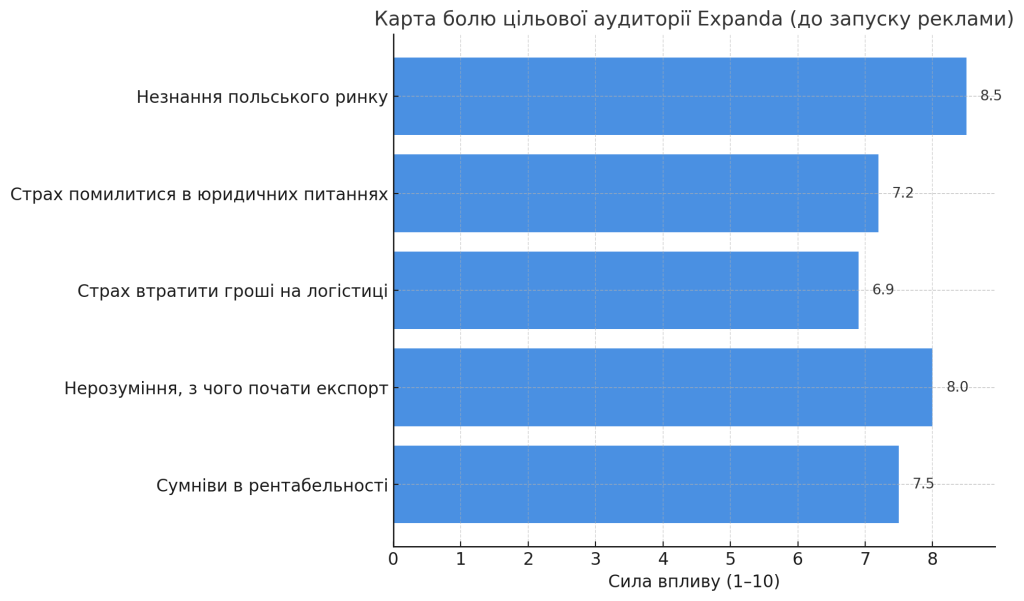
  • Identified key barriers to entry: fear of mistakes, distrust of the process, ignorance of the Polish market

4 hypotheses were formulated:

1️⃣ Entrepreneurs with e-commerce businesses in Ukraine respond better to an offer with support, rather than just a consultation.

2️⃣ Interest in Shopify is a good trigger for export intent: users are looking for automation and expansion.

3️⃣ Creatives built on pain (fear of exporting, logistics, risks) work better than rational arguments.

4️⃣  Initial traffic should be directed to the website, not to a lead form, to warm up the user and test behavior.

What did we do:

  • We divided the traffic into two audiences: e-commerce and Shopify;
  • We created 3 creatives in two styles (emotional and expert);
  • We set up analytics: Meta Pixel via the event API to track key interactions;
  • We allocated $20 per day for the test.

We first analyzed user behavior, then optimized creatives, and only then gradually increased our budget. This consistent approach provided confidence in each subsequent step.

Stages of project implementation

1. Product and audience pain analysis

We conducted a Pain Mapping – a method of structuring barriers to decision-making, especially effective in B2B with a high check.

What we were looking for: fear of not knowing the Polish market, losing money, doubts about logistics. These were the points that formed the basis of the creatives.

📌 The Pain Mapping framework helps structure key audience fears: from functional to emotional. Suitable for high-value offers.

Графік основних страхів і бар’єрів аудиторії Expanda перед експортом

2. Strategy and hypotheses

We built a matrix: audience — creative — offer. We set a minimum budget ($20 per day) for testing with rapid iterations.

3. Creating creatives

We prepared creatives in three formats to close different audience triggers:

  • Expert — with numbers, offers, and benefits. Showed growth potential and real results.
  • Emotional — spoke in the language of fears: “What about logistics? What if it doesn’t pay off?” Included Expanda’s support and expertise.
  • Provocative — with rhetorical questions that provoke action: “Are there stable sales in Ukraine? And in Poland?”

The combination allowed us to test hypotheses and find the most effective connections for a cold audience.

Рекламний банер з оффером виходу на польський ринокРекламний банер для українських брендів з товарами для експорту

4. Technical training

🔹 created an advertising account

🔹 connected Meta Pixel

🔹 configured basic data capture through tables for analyzing results

This allowed us to gather a complete picture of user behavior on the site, see what actions they take, and correctly assess the effectiveness of each stage of the funnel. Without this solution, we would not have been able to accurately understand what is working and what is not.

5. Running a test and tracking

Launched 3 audiences, 3 creative formats.

Metrics: CTR, site view depth, interaction with the application form.

We tested not just ads, but the entire “audience – creative – offer” relationship. This approach allowed us to quickly identify which audience responds best and which creatives need optimization.

6. Optimization

Every 2 days we reviewed campaign metrics: CTR, number of applications, cost per lead. Based on the accumulated data, we made optimization decisions.

During the testing phase, we also conducted additional experiments with display settings:

  • turned off advertising for those who had already submitted an application;
  • temporarily turned off advertising for users who had already seen creatives;
  • tested scenarios where repeated impressions were completely limited.

The results showed that completely disabling repeat impressions worsened performance: there were fewer applications, and their cost increased.

We concluded: in B2B audiences, the decision is not made on the first touch. People need to see the ad several times to mature into an application.

Returning to a strategy with limited repeated impressions (retargeting) gave a better result in both the number of applications and the cost of acquisition.

7. Summing up and scaling

We identified working segments and creatives, and prepared recommendations for scaling.

“The most valuable thing was in the first month: we quickly understood which connections worked. Experiments gave us the answers.”

Tools used

  • Meta Ads — the main channel
  • A/B testing — test creatives, audiences, offers
  • Pain Mapping — pain map of the target audience
  • Google Analytics + Pixel — analytics and behavior tracking
  • Google Sheets, Telegram — statistics and fast communication

📌 Example: We focused on cost per click, CTR, and number of site interactions. If the metrics were below the benchmark, the test audience-creative relationship was optimized or disabled.

Key results for the period

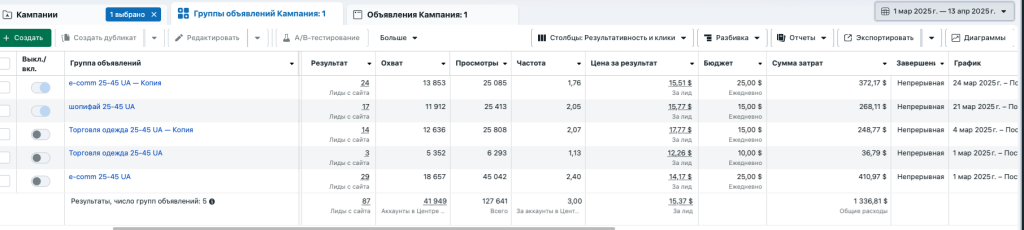
🔷 Number of leads: 87 applications received from the site in 6 weeks. These are the first system applications for the service, without which the product could not scale.

🔷 Average cost per lead (CPL): $15.37. For a B2B niche with a high check, this is 2–3 times lower than the average market indicator.

🔷 Best CTR: 3.1% — on creative focused on fears and risks of export. This is higher than the average rate for Meta Ads (1.5–2%).

🔷 Audience effectiveness: the best results were shown by the e-commerce segments 25–45 years old and the Shopify audience. In these groups, we received 70% of all applications.

🔷 Funnel and scaling: a funnel ready for scaling was built based on data — with customized analytics, segmentation, and ready-made creatives.

Фінальний скріншот результатів рекламних кампаній Expanda

What did it give the client?:

  • A system where you can see what works and how much it costs
  • Confirmation of demand for the product
  • Ability to scale promotion without modifications

“We are no longer afraid of the budget. We understand what we will get in return.” — Volodymyr Chorniy

attention

What to take away from this project

  • Even a $600 budget is enough if you test hypotheses and track user behavior
  • In B2B, you can’t focus only on clicks — depth and motivation are important
  • Advertising is not about creativity, but about the funnel and systematicity

📎 According to Harvard Business Review, B2B companies that have built systemic marketing grow 1.6 times faster than those that rely on personal connections.

Checklist: How to Repeat the Approach

🔹 Conduct a pain analysis and segment your target audience

🔹 Formulate 3–5 hypotheses (audience + offer + delivery)

🔹 Start with $20–30/day — don’t pour the entire budget in at once

🔹 Use a website, not a lead form (at the start)

🔹 Set up analytics before launch

🔹 Iterate every 2–3 days

🔹 Document everything: this is the basis for scaling

Final conclusion

B2B companies often face fears: how to test a product without risk, how not to blow the budget, and whether it is worth investing in advertising at all without guarantees of results.

Our experience with the Expanda project has shown: even without a history of previous advertising, you can build a working funnel, test demand, and get system applications at an adequate cost. The key to this is a systematic approach: analyzing audience pain points, properly testing hypotheses, and regularly optimizing based on data.

It is especially important to consider the behavior of the B2B audience: the decision to abandon the application is often made not from the first contact. We experimented with different display scenarios – and proved that repeated contacts with advertising have a critical impact on results. It was through retargeting and careful reminders that the cost of the application was significantly reduced.

Therefore, in B2B, it is important not only to launch advertising correctly, but also to work competently with the audience after the first touch: to give the solution time to warm up and mature.

If you need to not just “launch advertising,” but build a predictive customer acquisition model with clear analytics and controlled costs, we are ready to help.

    How to contact you?

    We will contact you within 30 minutes

    Privacy Policy
    Our cases
    #real estate
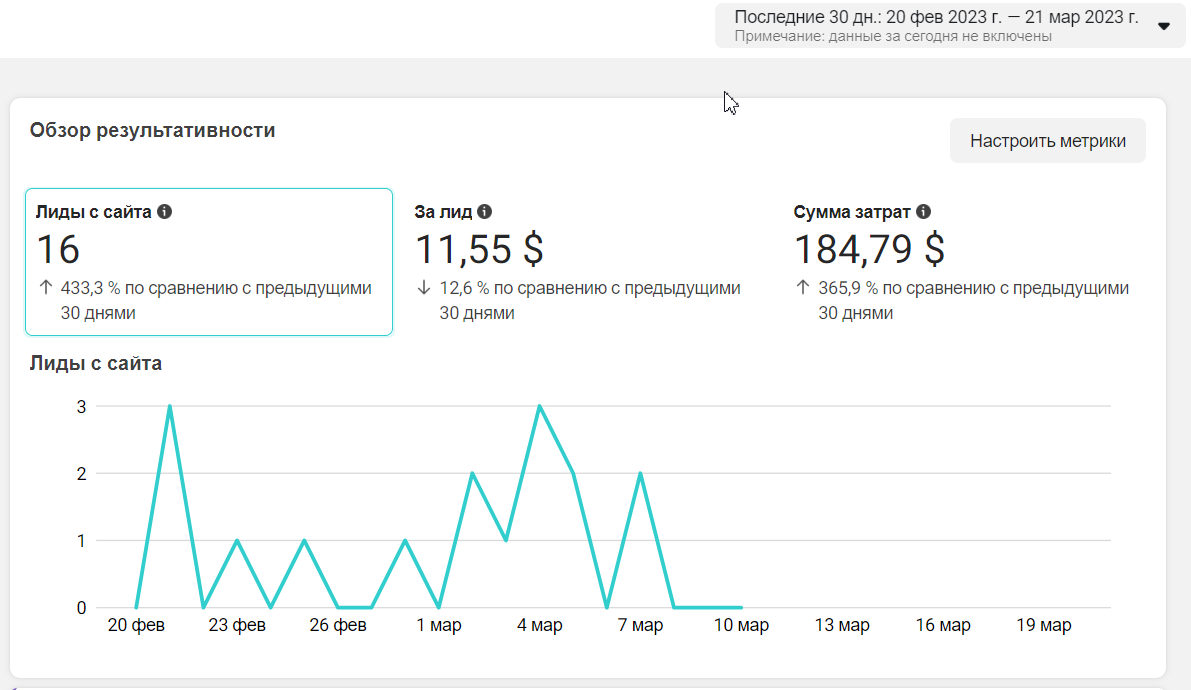
    Escape Villas: test campaign in Bali generated 16 leads worth $11.55 in 3 days
    Escape Villas: test campaign in Bali generated 16 leads worth $11.55 in 3 days
    Результати
    CPL: 11,55
    image_2023-03-21_19-53-27
    #e-commerce
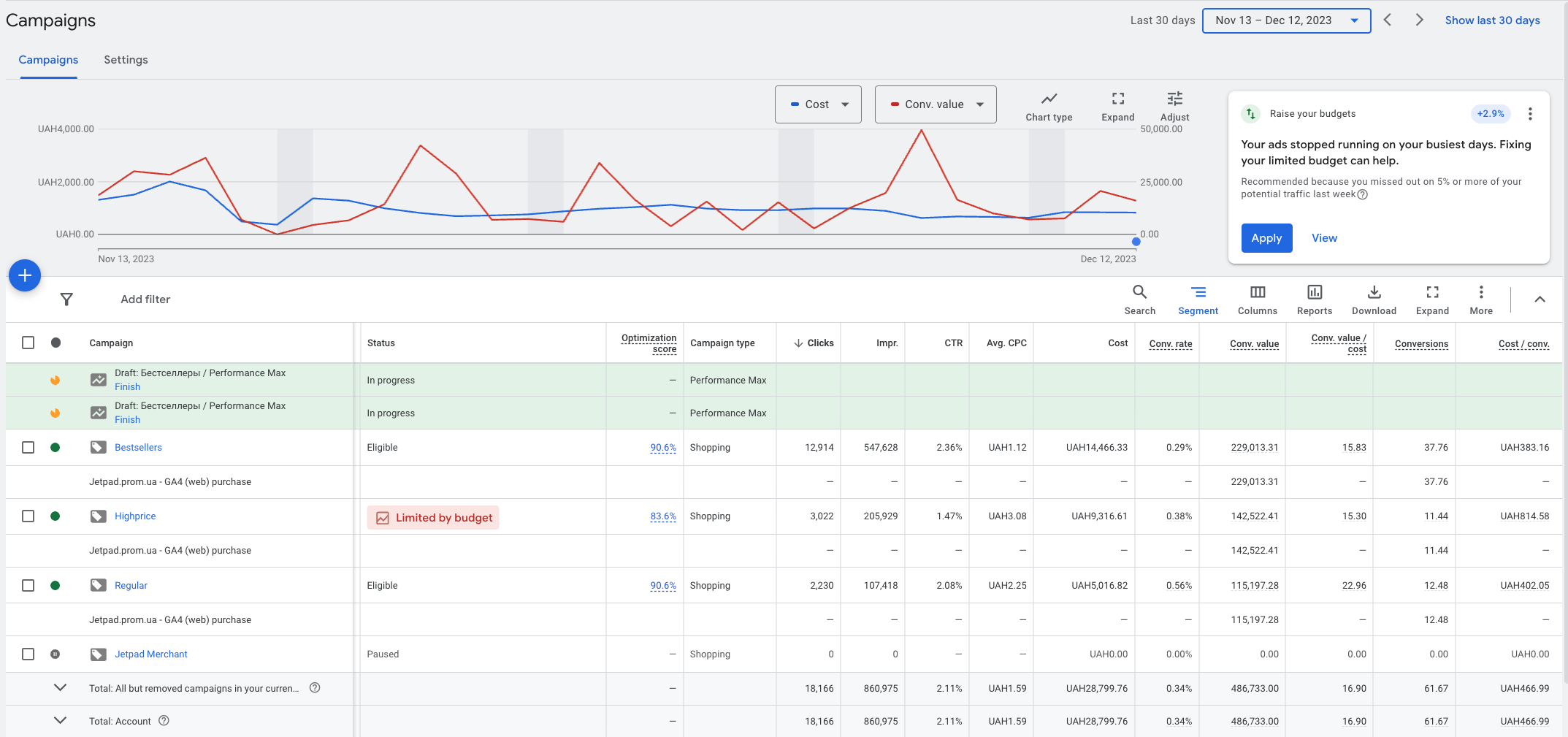
    How JetPad increased sales by 27x and improved advertising ROI by 3.5x thanks to an effective promotion strategy
    How JetPad increased sales by 27x and improved advertising ROI by 3.5x thanks to an effective promotion strategy
    Результати
    ROI: 16,69
    ROMI: +1569%
    Number of requests: 240
    Untitled (10)
    #e-commerce
    How we increased ROAS to 357% for a bridal veil brand in the US: Maria Veils case study
    How we increased ROAS to 357% for a bridal veil brand in the US: Maria Veils case study
    Результати
    ROI: 1252%
    KPI: achieving ROAS > 9.35 with a budget of $10.6K
    ROMI: 9,35
    CPL: 2,39$
    CPC: 0.67$
    Untitled (12)
    #e-commerce
    MKL: how we stopped the traffic drop and brought the site to the TOP for commercial queries
    MKL: how we stopped the traffic drop and brought the site to the TOP for commercial queries
    Результати
    ROI: +124,28%
    KPI: +145.76% organic traffic
    120,471 (organic) переходів
    image (28)
    #education
    NewTimeDevelopment: held a workshop with 399 participants and received an ROI of 212%
    NewTimeDevelopment: held a workshop with 399 participants and received an ROI of 212%
    View 100+ other cases